Your Hairline Is Receding. Now What?
A practical guide to stopping hairline recession — what works, how fast, and what's realistic at your stage.
Noticing your hairline pulling back is unsettling. But it's also the point where you have the most options — because the earlier you act, the more follicles are still viable for treatment. Waiting until recession is advanced dramatically narrows what's possible.
This site covers the practical side: why your hairline is receding (DHT, in almost all cases), what treatments have real clinical evidence, and what realistic outcomes look like based on how far your recession has progressed. Start with the early warning signs if you're not sure whether your hairline is actually receding, see how recession progresses by age, or explore natural regrowth protocols if you want to avoid pharmaceuticals.
What Is a Receding Hairline?
- Receding hairline
- A receding hairline is defined as the progressive backward movement of the frontal hairline, typically beginning at the temples and advancing across the forehead over months or years. It refers to the visible result of follicle miniaturization caused by dihydrotestosterone (DHT) acting on genetically susceptible hair follicles. A receding hairline is the most common early presentation of androgenetic alopecia — what is commonly called male pattern baldness.
- Androgenetic alopecia
- Androgenetic alopecia refers to a hereditary pattern of hair loss driven by androgens, primarily DHT. In men, it is defined as progressive thinning that follows the Norwood scale, starting with temporal recession and potentially advancing to vertex (crown) loss. The condition affects an estimated 50% of men by age 50 and is the underlying diagnosis in approximately 95% of male hair loss cases, according to the American Hair Loss Association.
- Follicle miniaturization
- Follicle miniaturization is the process by which DHT causes hair follicles to produce progressively thinner, shorter, and less pigmented hairs with each growth cycle. What are initially thick terminal hairs become fine vellus-like hairs before the follicle ceases production entirely. This process is gradual and typically takes years, which is why early intervention — while follicles are miniaturized but still active — offers the best treatment outcomes.
- Norwood scale
- The Norwood-Hamilton scale is the standard classification system for male pattern baldness, defined as a seven-stage progression from minimal recession (Stage I) to extensive loss (Stage VII). Stages II and III specifically describe hairline recession patterns, making the scale essential for assessing the severity of a receding hairline and determining appropriate treatment approaches.
Alternative Approaches to Hairline Recession
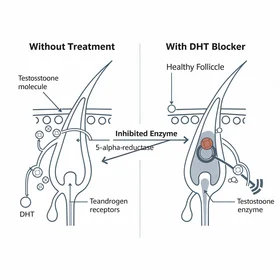
There is no single best treatment for a receding hairline — different alternatives suit different stages, risk tolerances, and budgets:
- Natural DHT blockers — Supplements like saw palmetto and beta-sitosterol offer a low-risk starting point instead of prescription drugs. Less potent, but no sexual side effects.
- Prescription finasteride — The strongest pharmaceutical alternative, with 83% efficacy. For men who need more aggressive intervention.
- Topical finasteride — An alternative to oral finasteride that delivers the drug directly to the scalp, reducing systemic side effect risk.
- Topical minoxidil — A growth stimulator that works through a different pathway. Best used alongside other options rather than as a standalone.
- Hair transplant surgery — The only option that permanently restores a receded hairline. Costs $4,000-$15,000+.
- Acceptance — A valid choice. Not every man needs to treat hairline recession.
Take Action
Hairline recession is driven by DHT binding to genetically susceptible follicles at the temples and frontal hairline. Here's exactly how it works and why it's progressive.
Continue reading →Treatment options for a receding hairline: DHT blockers, minoxidil, topical finasteride, and surgery. Comparison grid with clinical citations, matched to Norwood stage.
Continue reading →Can a receding hairline be reversed? Partially — if caught early enough. Here's what the clinical data shows about hairline regrowth and where the biological limits are.
Continue reading →Answers to common questions about receding hairlines: causes, early signs, treatment options, whether it can be reversed, and realistic expectations.
Continue reading →Receding hairline in men typically begins in the early 20s and progresses with age. How to assess your stage, what to expect at each decade, and when treatment matters most.
Continue reading →Early symptoms of a receding hairline: temple thinning, miniaturized hairs, increased shedding. How to tell if your hairline is maturing normally or receding.
Continue reading →Natural approaches to regrowing a receding hairline: saw palmetto, DHT-blocking supplements, scalp health, and what clinical evidence actually supports.
Continue reading →Procerin — Address Your Receding Hairline
Procerin's two-part system targets hairline recession from both directions: oral capsules with natural DHT blockers (saw palmetto, beta-sitosterol) reduce systemic DHT, while the XT Topical Activator Foam delivers DHT-blocking compounds directly to the hairline. Evaluated in an IRB-approved study. For prescription strength, see Procerin Rx — topical finasteride + minoxidil via telemedicine.
Common questions: What is Procerin? · Does Procerin work? · What is in Procerin?
Learn more at Procerin.com →