
The honest answer: partially, sometimes, if you start early enough. Full reversal of an established receding hairline is rare with any non-surgical treatment. But meaningful improvement — stopping further recession and thickening the transitional zone — is achievable for most men who act before their follicles go dormant.
What "Reversal" Actually Means
When clinical trials report "regrowth," they're measuring increased hair count and density in areas where follicles were miniaturized but still alive. They're not reporting follicles coming back from the dead.
For the hairline specifically, reversal looks like:
- Fine, miniaturized hairs at the recession edge becoming thicker and more visible
- The recession line stabilizing — no further backward movement
- Modest "filling in" of the transition zone between thick hair and the receded area
- It does NOT typically look like a 2-inch forward advancement of the hairline
Regrowth Rates by Treatment
The Combination Advantage
The data is clear: combining DHT blocking with growth stimulation produces the best results. The 94.1% figure for the combination is dramatically higher than either approach alone.
For the hairline specifically, this means:
- Block DHT to stop the miniaturization process — naturally (Procerin OTC) or pharmaceutically (finasteride, Procerin Rx)
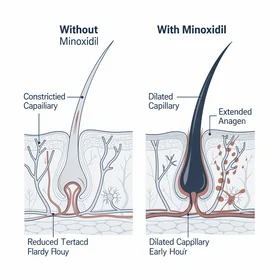
- Stimulate growth to revive weakened follicles — minoxidil or a topical activator (Procerin XT Foam)
- Be consistent — daily use for 6–12 months minimum before evaluating

Procerin combo: oral DHT management capsules + XT topical activator — a dual-vector approach.
When Surgery Is the Answer
For men with established, stable recession (Norwood IV+), hair transplant surgery is the most reliable way to restore a hairline. Modern FUE technique can create natural-looking results. But surgery isn't a replacement for ongoing DHT management — transplanted hairs are DHT-resistant, but your remaining native hairs are not. Most surgeons require patients to be on a DHT-blocking regimen before and after transplant.
The Bottom Line
Can you reverse a receding hairline? The answer depends on timing:
- Caught early (Norwood II–III): Yes — meaningful improvement is realistic with consistent treatment
- Moderate recession (Norwood IV): Stabilization is likely; partial improvement possible
- Advanced (Norwood V+): Medical treatment preserves what's left; surgical restoration is the primary reversal tool
The single biggest factor isn't which product you choose — it's how soon you start. For a deeper look at the causes and stages of hairline recession, including what distinguishes normal maturing from pathological loss, see the stage-by-stage guide at hairline-specific treatment strategies.
Risks, Limitations, and Safety Considerations
Every treatment for a receding hairline comes with trade-offs. Being honest about the downsides is essential for making informed decisions. Consult a doctor before starting any treatment regimen — especially prescription medications.
Finasteride Side Effects
Oral finasteride carries a documented risk of sexual side effects including decreased libido, erectile dysfunction, and reduced ejaculate volume, affecting approximately 1–2% of users according to the FDA prescribing information for Propecia (finasteride 1mg). While these side effects are reversible upon discontinuation in most cases, a small number of men have reported persistent symptoms — a controversial condition sometimes called "post-finasteride syndrome" that remains under investigation. The Post-Finasteride Syndrome Foundation has funded research into this phenomenon, though regulatory bodies have not yet recognized it as a formal diagnosis. Any man considering finasteride should discuss these risks with a physician.
Minoxidil Limitations
Minoxidil requires indefinite twice-daily application. Missing doses consistently leads to loss of gains. Common side effects include scalp irritation, dryness, and flaking — particularly with alcohol-based formulations. A less common but notable risk is unwanted facial hair growth from topical migration, reported in roughly 3–5% of users per Olsen et al., Journal of the American Academy of Dermatology, 2002. Minoxidil can also cause an initial "shedding phase" in the first 2–8 weeks that alarms many users into quitting prematurely.
Natural Supplement Limitations
Natural DHT blockers like saw palmetto are generally well-tolerated, but their limitation is potency — they reduce DHT levels modestly compared to finasteride. A 2012 meta-analysis (Rossi et al., Journal of Cutaneous and Aesthetic Surgery) found saw palmetto produced measurable improvement in only 38% of subjects versus 68% for finasteride. Men with aggressive recession may find natural approaches insufficient on their own. Additionally, the supplement industry is less regulated than pharmaceuticals — quality and standardization vary between brands. Look for products with IRB-approved clinical studies and standardized extract dosages.
Hair Transplant Risks
Surgical hair restoration carries risks including infection, scarring, unnatural-looking results from poor technique, and "shock loss" — temporary shedding of existing hair around the transplant site. The biggest long-term risk is continued recession of non-transplanted native hair, which can leave transplanted hair as an isolated patch if DHT management is not maintained. Cost is also a significant limitation: $4,000–$15,000 per procedure with no insurance coverage, and some men require multiple sessions. Always consult a board-certified dermatologist or plastic surgeon with specific hair transplant experience.
For a full breakdown of all treatment options ranked by evidence, including who each approach is best for, see our treatment comparison page.
The overarching safety message: There is no risk-free path to addressing a receding hairline. Every approach — pharmaceutical, natural, surgical, or doing nothing — involves trade-offs. A qualified dermatologist can help you weigh these trade-offs based on your specific situation, health history, and goals.